
The Official Process Has Not Opened, But Documentation Can Start Now
The Anti-Weaponization Fund has created significant public attention since the U.S. Department of Justice announced it on May 18, 2026. According to DOJ, the Fund was established as part of the settlement in President Donald J. Trump v. Internal Revenue Service and is intended to provide a process to hear and redress claims from people who suffered alleged “weaponization and lawfare.”
While the Fund has been officially announced, the practical claims process is still developing. As of now, potential claimants should not assume that an official application has been filed simply because they submitted information to a private organization, attorney, consultant, or website. Until DOJ releases final public instructions, the safest position is clear: the official process should be monitored through DOJ and other reliable sources.
That does not mean people should wait passively. For individuals, businesses, advocacy groups, nonprofit organizations, or public figures who believe they may have been harmed by improper government action, now is the time to begin organizing records. A future claim will likely be stronger if it is built on clear facts, documented events, and evidence of actual harm.
The DOJ announcement states that the Fund is expected to receive $1.776 billion from the federal Judgment Fund and may provide a systematic process for claims involving alleged lawfare or weaponization. DOJ also says the Fund must protect private information, avoid fraud, provide quarterly reports to the Attorney General, and stop processing claims no later than December 1, 2028.
A DOJ overview document further describes the Fund as a process for claims by Americans who suffered from lawfare and weaponization, defined there as the use of government power to target people for improper and unlawful reasons. The same overview states that the Fund can be audited, including by a third party, and that unused money will revert to the federal government.
For potential claimants, these details point to a practical reality: documentation will matter. Even if final rules have not yet been released, most formal claims processes require a claimant to explain what happened, when it happened, who was involved, and how the event caused harm. The stronger the timeline and supporting records, the easier it may be for an attorney, legal consultant, or future reviewer to understand the claim.
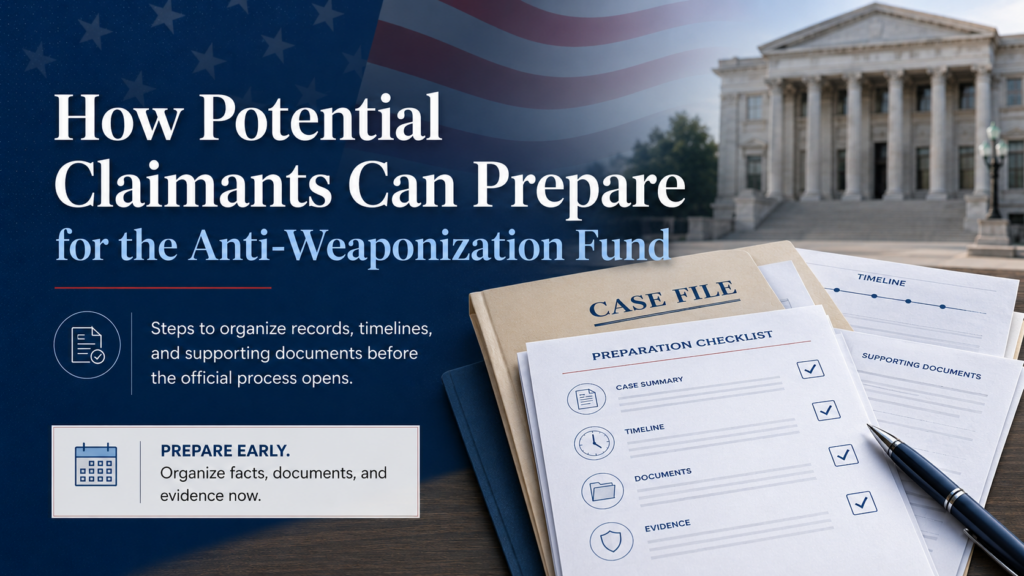
A useful first step is to write a simple case summary. This should not be emotional, exaggerated, or political in tone. It should be factual. A claimant should describe the key events, the government agency or office involved, the actions taken, and the outcome. The summary should also explain why the claimant believes the action was improper, selective, retaliatory, politically motivated, or otherwise connected to alleged weaponization or lawfare.
The next step is building a timeline. A timeline should list important dates in order, including when the claimant first received notice of a government action, when communications occurred, when legal proceedings began, when financial or professional harm appeared, and when the matter was resolved or continued. Timelines help reviewers quickly understand the sequence of events and identify gaps that may need additional explanation.
Potential claimants should also begin gathering supporting documents. Useful records may include agency letters, subpoenas, notices, court filings, administrative records, emails, text messages, public statements, news articles, financial records, employment records, professional licensing records, legal invoices, bank records, contracts, business records, or other materials connected to the alleged harm.
It is also important to organize evidence of damages. A person may believe they were treated unfairly, but a claim generally becomes stronger when harm can be shown. Potential damages may include legal fees, business losses, lost income, reputational damage, professional consequences, investigation costs, employment consequences, emotional hardship, or other measurable impacts. Where possible, claimants should preserve invoices, receipts, financial statements, employment records, and written communications.
Potential claimants should also be careful about privacy and sensitive information. Because these matters may involve legal, financial, professional, or personal details, documents should be stored securely. Claimants should avoid posting sensitive information publicly or sharing complete files with unverified parties. Before sending confidential materials to anyone, they should understand who is receiving the information, how it will be used, and whether an attorney-client relationship exists.
The need for caution is especially important because the Fund is already facing public debate and legal challenges. The Associated Press reported that lawsuits have been filed seeking to block payouts from the $1.776 billion Anti-Weaponization Fund, with critics arguing that the Fund lacks proper legal justification and oversight. Reuters also reported that legal experts believe challenges to the Fund may be difficult, partly because challengers may face standing issues and because the Judgment Fund is an established mechanism for paying certain federal settlements.
This legal uncertainty does not mean potential claimants should ignore the Fund. It means they should prepare carefully and avoid assumptions. The official process may be affected by future DOJ guidance, court rulings, congressional pressure, or administrative rules. A well-organized file will remain useful even if the process changes.
Anti-Weaponization Advisors is helping potential claimants begin that preparation. Our role is to help individuals and organizations organize their facts, structure timelines, identify relevant documents, and prepare information for independent attorney or legal consultant review. We do not act as the government, we do not file official DOJ claims before the official process opens, and we do not guarantee eligibility, approval, compensation, or any specific result.
The most important message for potential claimants is simple: prepare early, preserve documents, and stay factual. The Anti-Weaponization Fund is still developing, but claimants who organize their records now may be in a better position when official instructions become available.
Sources: U.S. Department of Justice, DOJ Anti-Weaponization Fund overview document, Associated Press, and Reuters.