
A Formal Review Process for Claims of Government Weaponization and Lawfare
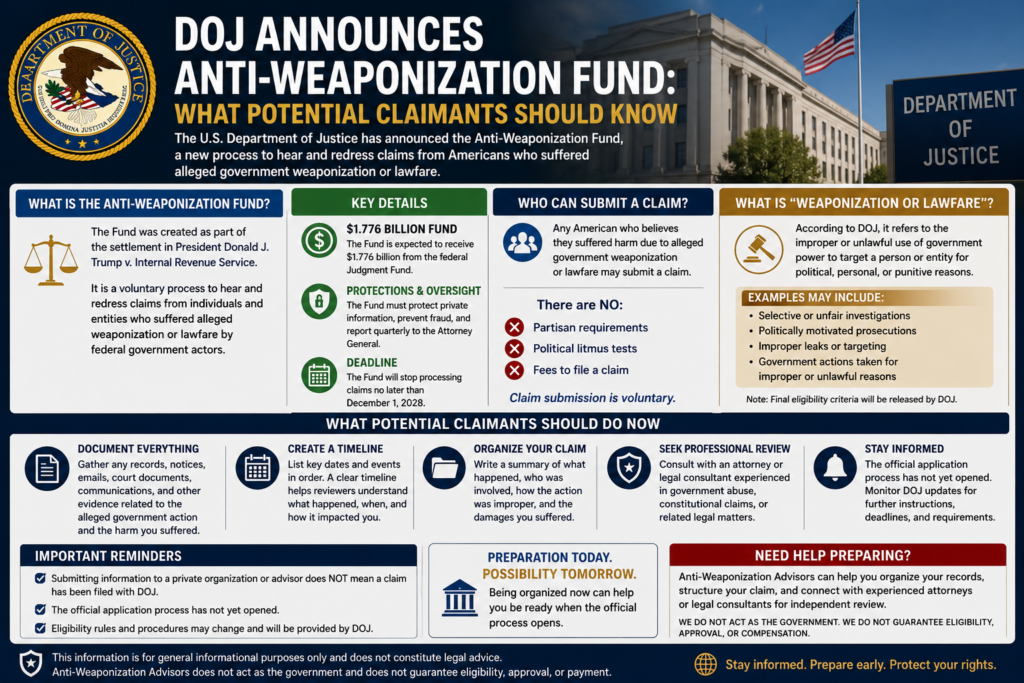
The U.S. Department of Justice has announced the creation of the Anti-Weaponization Fund, a new claims review process connected to the settlement of President Donald J. Trump v. Internal Revenue Service. According to the DOJ, the Fund was established to provide a systematic process to hear and redress claims from individuals, organizations, and entities who believe they suffered from government weaponization or lawfare.
The announcement has quickly become a major national development because it introduces a formal pathway for people who believe they were harmed by improper government action, selective enforcement, politically motivated investigations, or other alleged abuses of government authority. While the official application process has not yet opened, the DOJ’s announcement signals that future claimants may eventually have an opportunity to present their experiences, submit supporting evidence, and seek review.
The Fund was created as part of the settlement agreement in the Trump IRS case. That lawsuit involved claims connected to the alleged mishandling and disclosure of confidential tax information. Reuters reported that President Trump dropped the IRS lawsuit as part of an agreement that created a nearly $1.8 billion Anti-Weaponization Fund for legal claims. Reuters also noted that the DOJ has described the Fund as open to all eligible claimants, while acknowledging that the language around the Fund reflects themes often used by President Trump and his supporters regarding government weaponization.
According to DOJ materials, the Fund is not simply a payment tied to the Trump plaintiffs’ individual claims. A DOJ fund document states that the Anti-Weaponization Fund was created for broader claims involving alleged weaponization and lawfare, and that the funding is based on projected future claims from others.
This distinction is important. The Fund appears to be designed as a broader claims mechanism, not merely a private settlement payment. For individuals or organizations who believe they may have suffered harm from improper government conduct, that means the most important step right now is preparation: organizing facts, preserving documents, building timelines, and monitoring official DOJ instructions.
The DOJ has stated that the Fund may provide different forms of relief. A related settlement document says the Fund has the power to issue formal apologies and monetary relief to claimants where appropriate. However, this does not mean every person who submits information will qualify, nor does it mean that any payment is automatic. Like other claims review processes, eligibility, evidence, documentation, and final rules will likely matter.
At this stage, potential claimants should understand that the official application process has not yet started. There is no confirmed public claims portal, final eligibility checklist, or official submission procedure available for claimants as of now. Individuals should rely on DOJ updates and avoid assuming that a claim has been filed unless it is submitted through an official process once that process is opened.
Still, preparation can begin now. A strong claim will likely require a clear explanation of what happened, when it happened, which government agency or official was involved, and how the alleged conduct caused harm. Supporting materials may include government letters, court filings, agency notices, emails, public records, financial records, employment documents, media reports, legal bills, or other records that connect the alleged action to the harm suffered.
Potential harms may include financial loss, reputational damage, legal expenses, business disruption, professional consequences, emotional hardship, or other measurable impacts. The strongest submissions will likely be fact-based, organized, and supported by documents rather than general frustration or unsupported allegations.
National media coverage has also shown that the Fund is likely to remain under public and legal scrutiny. The Associated Press reported that legal challenges have already been filed seeking to block distributions from the $1.776 billion Anti-Weaponization Fund. Those lawsuits raise questions about legal authority, oversight, and how the Fund may operate. Reuters has also reported that the Fund has created political debate in Congress, including concerns from both Democrats and some Republicans regarding oversight and possible use of funds.
For potential claimants, these developments do not necessarily eliminate the possibility of future claims, but they do show why careful preparation is important. The rules, procedures, and timeline may continue to evolve as courts, Congress, and the DOJ address questions about the Fund’s structure.
Anti-Weaponization Advisors is monitoring these developments closely. Our role is not to act as the government, file official DOJ claims before the official process opens, or guarantee any result. Instead, we help potential claimants begin organizing their stories, documents, evidence, timelines, and case materials so they are better prepared when official guidance becomes available.
For individuals, businesses, nonprofit organizations, public figures, advocacy groups, or other entities who believe they were harmed by government weaponization or lawfare, now is the time to preserve records and begin building a clear factual history. That preparation may later help attorneys or legal consultants evaluate whether a matter may be appropriate for submission once the official process begins.
The Anti-Weaponization Fund is still developing. The DOJ announcement is the key official starting point, but additional procedures, rules, and deadlines are expected to be important. Until those details are released, potential claimants should stay informed, avoid misinformation, and focus on preparing accurate, organized, and well-supported documentation.
Important Notice: Anti-Weaponization Advisors is not a government agency and is not affiliated with the U.S. Department of Justice. We are not a law firm and do not provide legal advice. Our role is to help individuals organize information and connect with appropriate attorneys or legal consultants for independent review and possible advocacy.
Source: https://www.justice.gov/opa/pr/justice-department-announces-anti-weaponization-fund