
Why Documentation, Eligibility, and Independent Review May Matter
The Anti-Weaponization Fund continues to draw national attention as legal commentators, media outlets, and public policy organizations examine how the Fund may operate, who may qualify, and what safeguards will guide the review process. While the U.S. Department of Justice has described the Fund as a mechanism to hear and redress claims from Americans who suffered alleged lawfare or weaponization, several legal analysts have raised questions about oversight, eligibility, and administrative controls.
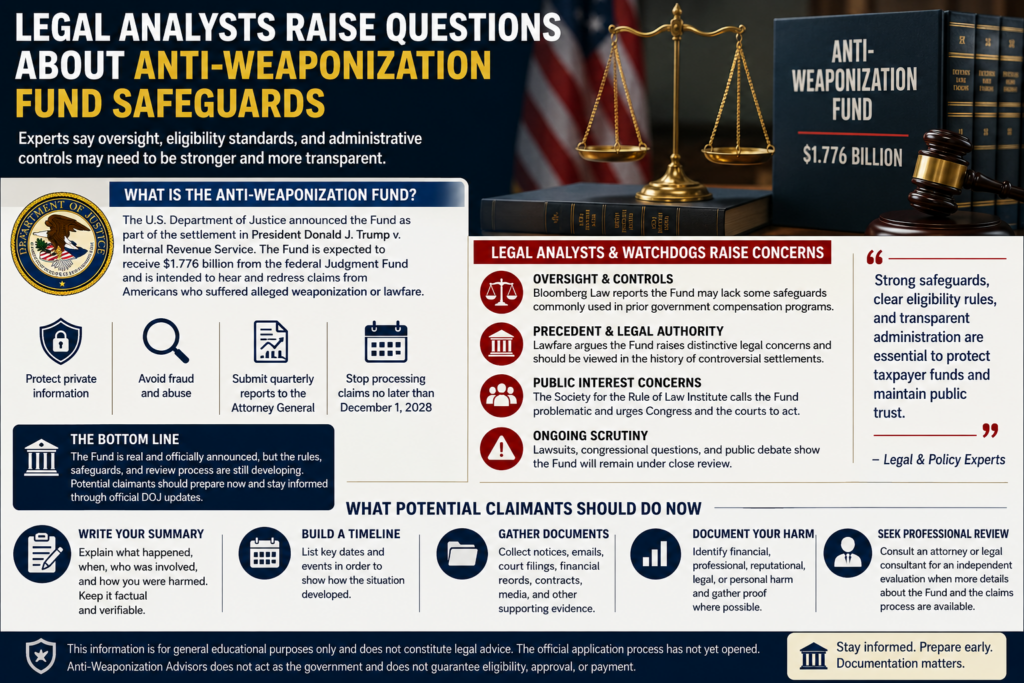
The DOJ announced the Fund in connection with the settlement of President Donald J. Trump v. Internal Revenue Service. According to the Department, the Fund will receive $1.776 billion from the federal Judgment Fund and is intended to provide a process for claims involving alleged weaponization or lawfare. DOJ also stated that the Fund must protect private information, avoid fraud, submit quarterly reports to the Attorney General, and stop processing claims no later than December 1, 2028.
Those official requirements are important, but legal observers are focusing on what comes next: the actual rules, procedures, eligibility standards, and review controls that will determine how claims are evaluated. Bloomberg Law reported that officials familiar with prior compensation programs believe the new Fund may lack some of the rigorous controls normally used in major government compensation programs created through settlements or congressional mandates.
That concern does not mean the Fund will fail, nor does it mean potential claimants should ignore it. Instead, it highlights a practical reality: claimants should prepare carefully and avoid relying on assumptions. If eligibility rules are later issued, a strong submission will likely need more than a general statement of unfair treatment. It may need a clear timeline, names of agencies or officials involved where known, supporting records, evidence of harm, and a direct connection between the alleged government action and the damage suffered.
Legal debate around the Fund is also tied to the federal Judgment Fund. The DOJ describes the Judgment Fund as a permanent appropriation that allows the government to settle and pay cases. DOJ has also pointed to the Keepseagle case as precedent for a claims fund created through settlement, noting that the Anti-Weaponization Fund will return unused money to the federal government.
However, legal commentators have questioned whether the Anti-Weaponization Fund fits comfortably within prior settlement practices. Lawfare published an analysis arguing that the Fund raises distinctive legal concerns and should be viewed in the broader history of controversial federal settlements. The article frames the Fund as part of a larger debate over how executive branch settlement authority and the Judgment Fund can be used.
The public debate has also included criticism from outside legal and civic organizations. The Society for the Rule of Law Institute issued a statement strongly opposing the Fund and calling for congressional and legal challenges. While that statement reflects a critical viewpoint, it is relevant because it shows that the Fund will likely remain under close scrutiny from watchdog organizations, lawmakers, and courts.
For potential claimants, this environment creates both opportunity and caution. On one hand, the DOJ announcement confirms that a formal claims process has been created for alleged weaponization or lawfare. On the other hand, the exact application process has not yet opened, and final eligibility standards have not been publicly released in full. That means nobody should assume approval, payment, or even qualification until official rules are available and a specific claim is reviewed.
The most responsible approach is to prepare early and prepare well. Potential claimants should begin by writing a factual summary of what happened. That summary should include dates, agencies involved, key communications, government actions taken, and the resulting harm. The summary should avoid exaggeration and focus on verifiable facts.
Next, claimants should gather supporting documentation. This may include agency letters, court filings, subpoenas, notices, emails, financial records, employment records, professional licensing documents, legal invoices, media reports, public records, or other materials connected to the alleged harm. In many cases, the strength of a claim may depend on whether the claimant can show not only that something happened, but that it caused measurable damage.
Claimants should also identify the type of harm involved. Possible harms may include financial losses, business disruption, legal expenses, reputational damage, professional consequences, loss of employment opportunities, personal hardship, or other impacts. Where possible, these harms should be supported by documents rather than only personal statements.
Independent professional review may be especially important because the Fund is still developing. Attorneys and legal consultants may help evaluate whether a matter appears connected to the Fund’s stated purpose, what documents are relevant, what facts need clarification, and whether the claimant should wait for official DOJ instructions before taking further action.
Anti-Weaponization Advisors is tracking official updates and public reporting about the Fund. Our role is to help potential claimants organize their information, prepare their case materials, and connect with appropriate attorneys or legal consultants for independent review. We do not act as the government, we do not file official DOJ claims before the official process opens, and we do not guarantee eligibility, approval, or payment.
The current legal commentary makes one point very clear: preparation matters. As public debate continues, potential claimants should focus on facts, documents, timelines, and credible evidence. Whether the Fund ultimately operates as announced or changes through court review, congressional action, or further DOJ guidance, well-organized records will put potential claimants in the strongest possible position.
The Anti-Weaponization Fund remains a developing issue. Anyone who believes they may have a claim should continue monitoring official DOJ materials, avoid misinformation, and begin organizing documentation now.
Sources: U.S. Department of Justice, Bloomberg Law, Lawfare, and Society for the Rule of Law Institute.